

Omias puberulus Boheman, 1834, une rareté probablement à reconsidérer (Coleoptera, Curculionidae)
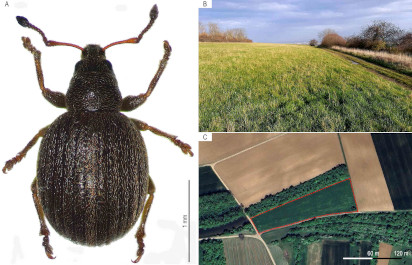 Extended abstract – Omias puberulus Boheman, 1834 is a small weevil, measuring 2.5 mm in length, that has long been known by the misapplied names Mylacus rotundatus (Fabricius, 1792) and Omias rotundatus (Fabricius, 1792). Found from Central and Eastern Europe to the Caucasus, this species is generally considered rare in France and western Germany. French literature provides only outdated or imprecise information, largely repeating Hoffmann's (1950) work, and even the 2024 Catalogue des Coléoptères de France offers only the discouraging note, "East of Paris. Search Beta”, overlooking the detailed records published for Alsace by Schott (1999). Similarly, recent data on the species in Baden-Württemberg are scarce, and it is listed as threatened (“Gefährdet”). Online platforms provide few French observations, often limited to a single location near Strasbourg, and general searches in French yield no useful information.
Prior to 2025, my own records were limited to one specimen collected on a limestone hill at Dahlenheim in 1985 and three individuals found on a loess slope near the A352 motorway at Altorf in 2007. However, on 14 November 2025, sweeping a small semi-natural meadow near the summit of the Stephansberg (Nordheim, Bas-Rhin; 350 m; Muschelkalk) yielded an unexpectedly large population of O. puberulus. Given the density observed in the net, the population likely exceeded 100 individuals per are, suggesting well over 10,000 beetles for this single plot of land.
These observations highlight a marked autumn emergence of new adults. The life cycle appears to consist of overwintering adults that become active in spring, larval development in summer and the emergence of new adults in autumn, which then overwinter. My October 2007 record supports this pattern. The species is also likely to be polyphagous, as neither Beta nor any Chenopodiaceae were present at the site, which is consistent with earlier Alsatian and German data. The strong activity observed in mid-November was clearly promoted by unusually warm conditions (up to 18 °C locally the day before sampling).
Entomologists often avoid late-season surveys due to low temperatures, humidity and difficult sweeping conditions. However, the abundant autumn population of O. puberulus, which was active even under cool, damp conditions, suggests that late-season sampling can reveal overlooked faunal components. Further surveys on similar calcareous hills (Bas-Rhin Muschelkalk outcrops, vineyard hillsides and Hardt gravels) are needed to confirm whether this autumn abundance is typical of the species. While numerous spring and summer surveys exist for these sites, late-autumn data are virtually absent. The Nordheim survey also revealed a diverse accompanying fauna, reminding us of the richness that can be accessed through late-season fieldwork.
Keywords – Calcareous grassland, autumn emergence, population density, field survey methods, biogeographical records
CITER CET ARTICLE
Callot H. 2025. Omias puberulus Boheman, 1834, une rareté probablement à reconsidérer (Coleoptera, Curculionidae). Bulletin de la Société d'Histoire naturelle et d'Ethnographie de Colmar, 81 (14) : 141-144. https://doi.org/10.5281/zenodo.17763438
INFORMATIONS BIBLIOGRAPHIQUES
Type de contribution : Note | Short communication
Editeur :
Revue :
Évaluation : article évalué par les pairs
Langue : Français
Soumis le 25 novembre 2025
Publié le 05 décembre 2025
Droits d’auteur : © 2025, l’auteur. L’auteur conserve ses droits et accorde à la SHNEC une licence non exclusive de publication et de diffusion.
DOI :

Licence :
 https://creativecommons.org/licenses/by/4.0/deed.en